Healthy Skepticism vs. Rabbit Holes: How to Ask Real Questions and Actually Get Somewhere
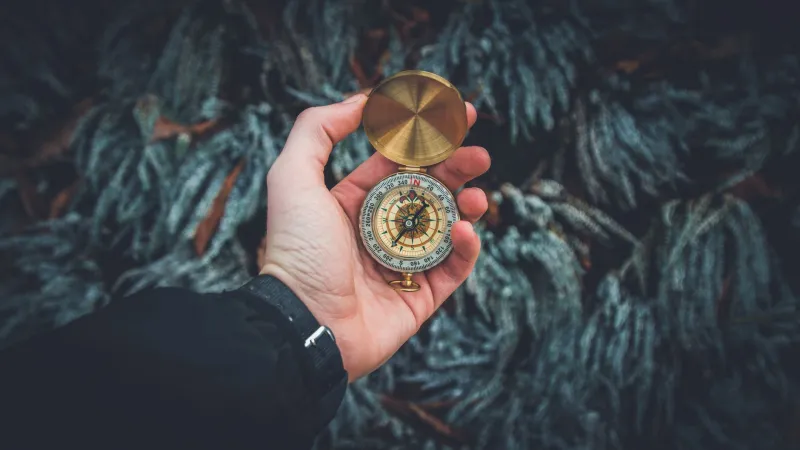
Questions are supposed to be the starting line, not the finish line.
Somewhere along the way, though, "just asking questions" became a rhetorical move — a way to plant seeds of doubt without ever committing to an argument that could be challenged or disproven. You've probably seen it. Someone posts a string of leading questions about a news story, a vaccine, an election result. They're not claiming anything, technically. They're just asking. And somehow, the questioning itself becomes the point — with no apparent interest in finding actual answers.
That's a problem. Not because questions are bad, but because that pattern isn't really inquiry at all. It's theater.
At the same time, there are plenty of situations where questioning official sources, scientific consensus, or mainstream narratives is not only reasonable but important. Institutions have been wrong. Experts have been compromised. Studies have been retracted. Healthy skepticism isn't the same thing as cynicism or conspiracy thinking, and it's worth knowing how to tell them apart — especially in yourself.
What Bad-Faith Questioning Actually Looks Like
Bad-faith questioning has some pretty recognizable features once you know what you're looking for.
First, it tends to treat doubt as a destination rather than a starting point. The goal isn't to find out what's true — it's to establish that you can't really know anything for sure, so why trust any of it? This is sometimes called "doubt-mongering," and it shows up constantly in arguments about climate science, vaccine safety, election integrity, and public health.
Second, bad-faith questions are often asymmetric. They demand extraordinary evidence from official or mainstream sources while accepting thin or anecdotal evidence from alternative ones. "How do we really know the vaccine is safe?" is treated as a profound challenge to the entire pharmaceutical establishment, while a celebrity's personal testimony about an unproven supplement is taken at face value.
Third, and this is subtle, bad-faith questioning tends to be unfalsifiable. There's no answer you could give that would actually resolve the question, because the point isn't resolution. If you provide evidence, it's dismissed as coming from a compromised source. If you point to expert consensus, that just proves how deep the conspiracy goes. The questioning loop never closes.
None of this means everyone asking uncomfortable questions is acting in bad faith. Plenty of people have picked up these habits without realizing it — because they're swimming in information environments that reward performative skepticism over genuine inquiry.
Signs Your Own Skepticism Might Be Drifting
This part is harder, because it requires some honest self-examination. A few patterns worth watching for in your own thinking:
You've stopped updating. Real inquiry changes your mind sometimes. If you've been "researching" a topic for months or years and your conclusions have only ever gotten more entrenched, that's worth examining. Evidence is supposed to move the needle.
Your sources all point the same direction. Genuine research means engaging with sources that challenge your working hypothesis, not just ones that confirm it. If every link you click reinforces what you already believed, you may have built yourself an echo chamber without noticing.
You're more interested in exposing than understanding. There's a difference between wanting to know what's true and wanting to catch someone in a lie. Both can look like research from the outside, but they lead to very different places.
The experts who agree with you are always the brave truth-tellers; the ones who don't are always compromised. This is a convenient framework that happens to make your existing views immune to expert challenge. Real fields have genuine expert disagreement — learning to navigate it is more useful than assuming the minority view is always the suppressed truth.
A Framework for Productive Inquiry
Okay, so if you want to ask real questions and actually get somewhere, what does that look like?
Start with a falsifiable question. "Is there something wrong with how this study was conducted?" is a better starting point than "Why don't they want us to know the truth?" One of those can actually be answered. Make sure your question is the kind that evidence could, in principle, resolve.
Map the landscape before you dig. Before going deep on any claim, do a quick scan of what the mainstream scientific or expert view actually is, and why. Not because consensus is always right — it isn't — but because you need to understand the argument you're challenging before you can meaningfully challenge it.
Follow the methodology, not just the conclusion. When you're evaluating a study or report, the most important questions aren't "does this support what I think?" but "how was this done, who funded it, what were the sample limitations, and has it been replicated?" Those questions work equally well on sources you like and sources you don't.
Look for what would change your mind. Explicitly ask yourself: what evidence, if I found it, would convince me I was wrong? If you can't answer that, your inquiry has already stalled.
Trace claims to primary sources. A lot of misinformation travels through a game of telephone — a study gets summarized by a journalist, the summary gets quoted by a blogger, the quote gets screenshotted and shared without context. Go back to the original when you can. You'll often find the original claim was much more limited than the version that went viral.
Where to Turn When You Don't Trust the Usual Sources
This is a fair concern. Institutions have credibility problems, and trust in media, government, and science is at historic lows in the US for reasons that aren't entirely unfounded.
But "I don't fully trust Source A" doesn't automatically mean "I should trust Source B" — especially when Source B has even fewer accountability mechanisms. A few genuinely useful moves:
- Look for primary literature. PubMed is free and searchable. The full text isn't always available, but abstracts usually are, and they'll tell you what a study actually claimed.
- Seek out science communicators with track records. People who have been explaining science accurately for years, who correct themselves publicly when they're wrong, and who engage honestly with criticism are more trustworthy than those who only ever say what their audience wants to hear.
- Use fact-checking as a starting point, not an endpoint. Sites like Snopes, PolitiFact, and Skeptical Science aren't infallible, but they do cite their sources — which means you can check their work.
- Ask a librarian. Seriously. Reference librarians at public and university libraries are trained in exactly this kind of source evaluation, and many offer free research help.
The Real Goal
Genuine inquiry is messy. It involves sitting with uncertainty, updating your views when evidence warrants it, and sometimes arriving at "I don't know yet" as a legitimate answer. That's uncomfortable in a culture that rewards confident takes.
But that discomfort is actually a sign you're doing it right. The goal of asking questions was never to feel certain — it was to get closer to what's true. Keep that destination in mind, and the questions you ask will start to look a lot different.